 By Author
In the dynamic landscape of Indian business, cash flow is the lifeblood that keeps enterprises thriving. Yet, thousands of Micro, Small, and Medium Enterprises (MSMEs) face a critical challenge: outstanding invoices that take 30, 60, or even 90 days to convert into actual cash. This waiting game can cripple operations, stall growth, and force businesses to miss golden opportunities.
To overcome this cash flow bottleneck, businesses are increasingly turning to Purchase Invoice Discounting, a structured financing solution designed to convert pending invoices into immediate liquidity. At FinAGG, we’ve witnessed firsthand how this mechanism has empowered over 2 lakh+ MSMEs across India, helping them navigate cash flow crises with confidence and grow their businesses sustainably at remarkably competitive interest rates.
This comprehensive guide will take you deep into the world of purchase invoice discounting, exploring every aspect from regulatory frameworks to practical implementation strategies, and why it’s become the preferred choice for forward-thinking businesses.
What is Purchase Invoice Discounting?
Purchase Invoice Discounting is a short-term financing arrangement where businesses sell their unpaid invoices (accounts receivable) to a financial institution or specialized platform at a discounted rate to receive immediate cash. Instead of waiting weeks or months for customers to settle their dues, businesses can unlock up to 80-95% of the invoice value within 24-48 hours.
Think of it as converting your future revenue into present-day working capital without taking on traditional debt.
Types of Purchase Invoice Discounting Models
1. Buyer-Led Discounting: The buyer initiates financing to ensure timely supplier payment and maintain procurement continuity.
2. Supplier-Assisted Financing: Suppliers collaborate with financing partners to offer credit flexibility to buyers.
3. Anchor-Based Financing: Large corporate buyers act as anchors, enabling smaller vendors or distributors to access financing based on the anchor’s creditworthiness.
4. Platform-Based Discounting: Fintech-driven models like FinAGG integrate data analytics, GST verification, and automated underwriting for faster approvals.
How It Works
The purchase invoice discounting process follows a streamlined workflow:
Step 1: Invoice Generation & Submission Your business delivers goods or services to a client and generates an invoice with payment terms (typically 30-90 days). This invoice is then submitted to the discounting provider along with supporting documentation.
Step 2: Verification & Due Diligence The financial institution verifies the invoice authenticity, checks the creditworthiness of your buyer, and assesses the transaction validity. This process has been significantly accelerated through digital platforms and ERP integrations.
Step 3: Fund Disbursement Upon approval, you receive an advance usually 80-90% of the invoice value credited directly to your business account. This typically happens within 24-48 hours, sometimes even on the same day.
Step 4: Customer Payment On the due date, your customer pays the invoice amount directly to you (in confidential invoice discounting) or to the financing provider (in disclosed arrangements).
Step 5: Final Settlement Once the customer settles the invoice, the provider releases the remaining balance (minus the discounting fee) to your account, completing the transaction cycle.
Key Players in the Invoice Discounting Ecosystem
- The Seller (Your Business): The entity that has provided goods/services and holds unpaid invoices
- The Buyer (Your Customer): The entity obligated to pay the invoice
- The Financier: Banks, NBFCs, or fintech platforms like FinAGG that provide the discounting facility
- TReDS Platforms: RBI-regulated electronic platforms facilitating invoice discounting for MSMEs
FinAGG’s Invoice Discounting Offering
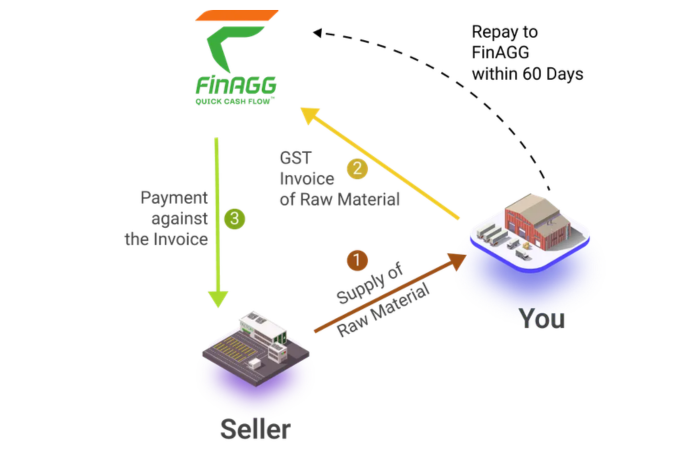
From FinAGG’s standpoint, invoice discounting is central to its channel financing suite. FinAGG partners with large anchor corporates (like FMCG companies) to extend credit deep into distribution networks. Their “Stock Now Pay Later” service lets distributors purchase inventory from brands on credit. Key points of FinAGG’s solution:
- Digital First: MSMEs apply via FinAGG’s mobile/web app, linking their GST records and banking. The platform performs e-KYC (Aadhaar, UDYAM certificate) and harnesses APIs (India Stack) to verify invoices against GST filings.
- Anchor Integration: FinAGG works with anchor brands and banks. For example, if an ITC distributor uploads sales/purchase data, FinAGG uses the anchor’s credit rating to offer better terms. This reduces risk and may lower interest.
- Financing Products: FinAGG offers both Purchase Invoice Financing (for buying inventory) and Sale Invoice Financing (for receivables). Loans are short-term (15–90 days) synced to payment cycles. Clients see a credit limit (up to ₹50 lakh as per some FAQs) based on business size.
- Affordable Rates: As a NBFC partner, FinAGG can price its loans around 11% p.a., which it advertises as “low interest”. This is achieved by efficiency and high transaction volume. The India Today report that TReDS is 5–8% cheaper provides industry validation that sub-12% rates are indeed competitive.
- Success at Scale: While detailed data are proprietary, FinAGG cites supporting 200,000+ MSMEs (2 lakh) so far, spanning urban and rural markets. These enterprises received over ₹10,000+ crore in funding (actual figure may be corporate) through FinAGG, cushioning them during cash crunches. Many of these loans were driven by partner use-cases like ONDC integration for MSME lending.
- Risk Management: FinAGG underwrites using its FAME Score, which draws on GST flows, banking data, and business profiles. In practice, FinAGG often requires buyers’ acceptance for sales invoices (mirroring TReDS), or uses anchor credit for purchase finance. Its partnership with regulated lenders means the loan is ultimately held by an NBFC or bank under RBI oversight.
- Customer Experience: FinAGG emphasizes a paperless, user-friendly journey. For instance, the GST Sahay platform allows a step-by-step guided application (upload PAN, Aadhaar, bank statements, invoice upload) without branch visits. Approval and disbursal happen quickly, addressing urgent working capital needs.
Overall, FinAGG’s model showcases how fintech innovation can operationalise invoice discounting at scale. By blending RBI-compliant NBFC credit, blockchain-inspired scorecards, and digital platforms, it delivers an end-to-end solution aligned with regulations. MSMEs on FinAGG not only avoid collateral and paperwork but also integrate seamlessly with national digital infrastructure (like Udyam and ONDC) for transparency and speed.
Frequently Asked Questions (FAQs)
1. What exactly is purchase invoice discounting, and how is it different from normal invoice discounting?
Purchase invoice discounting is essentially reverse factoring. It allows a business to borrow funds against invoices for purchases (payables) rather than sales (receivables). In practice, a supplier issues a purchase invoice to you (the buyer). Under purchase invoice financing, a lender advances you money to pay that supplier immediately, based on that invoice. You then repay the lender later when you have cash flow from sales. In contrast, sale invoice discounting (factoring) involves an MSME selling its sales invoices to a financier for quick cash. Both improve cash flow but one helps you pay suppliers, the other helps you collect from customers.
2. Who can use invoice discounting? Can any MSME apply?
Generally, any registered MSME with valid GST and business credentials can apply. For sale invoice discounting, your buyer usually needs to be an RBI-approved corporate or government entity (especially on TReDS). For purchase invoice discounting, the financier will require documentation of the purchase contract/invoice and may consider the creditworthiness of the seller (your supplier). Fintechs like FinAGG often focus on businesses in specific supply chains (e.g., distributors of FMCG brands) but many open-account MSMEs can also apply. You should have at least a 1–2 year business track record and sufficient GST sales/purchase history.
3. What documents do I need to submit for invoice financing?
Typically you need: PAN and Aadhaar of the business proprietor or directors, Udyam (MSME) registration certificate, GST registration, company/partnership documents (MOA, AOA, deed), recent bank statements (last 6–12 months), audited financials (if applicable), and the invoices you wish to finance. On platforms like FinAGG’s GST Sahay, the process is fully digital: you upload GST return details, bank statements, and the invoice itself. The platform cross-verifies these with government databases.
4. What interest rates and fees will I be charged? How is the cost calculated?
Rates vary by lender and platform. As a benchmark, TReDS auctions have yielded effective annual rates in the mid-teens for many MSMEs, but often 5–8% lower than traditional loan rates. Fintech lenders like FinAGG may start around 10–12% p.a. for short tenors (as low as 11% advertised). You’ll also pay a processing fee (usually a small percentage of the invoice value, e.g. ~1–3%). The total cost is interest + any fees, prorated to the loan term. Always ask for an annualized rate for full clarity.
5. Do I need to provide any collateral or guarantee?
No collateral is typically required beyond the invoice itself. RBI-approved TReDS financing is expressly collateral-free for the MSME. FinAGG and similar fintech lenders also offer unsecured invoice advances – they rely on the assigned receivable as security. In effect, your buyer’s promise to pay is the guarantee. If using an NBFC factor, some may still require personal guarantees from business owners if your credit rating is low.
6. What happens if my customer (buyer) does not pay the invoice? Am I still responsible?
On RBI-licensed platforms like TReDS, the financing is without recourse to the MSME. This means if the buyer defaults, the financier cannot demand the money back from you – the financier bears the loss. However, outside TReDS, terms can vary. If you use a private NBFC factor or fintech not following TReDS rules, the contract may make you responsible. Always clarify: on TReDS, RBI says the MSME “would not have to pay” the financier in case of buyer default. For safety, try to work with reputable financiers and ensure contracts mirror this non-recourse structure.
7. How quickly can I get the funds?
That’s one of the main benefits. Once invoices are approved and bids selected, platforms usually transfer funds within 24–48 hours. FinAGG advertises “loan disbursement in less than 24 hours” after approval. The bottleneck is mostly documentation and acceptance. If you have everything ready and your buyer promptly accepts the invoice (on TReDS), the cash is almost immediate.
8. Can I prepay the financing early or foreclose the loan?
Yes. Most invoice financing arrangements do not have prepayment penalties. For example, FinAGG explicitly offers no pre-closure charges. Since the loan term matches the invoice due date, early repayment simply means closing the advance sooner. In TReDS, you repay when the buyer pays the invoice, so prepayment is basically receiving the buyer’s payment a bit early, which is fine.